UNDERSTANDING CONSTRUCTION COSTS IN THE BAHAMAS
WHY A SIMPLE COST-PER-SQUARE-FOOT FIGURE CAN BE MISLEADING
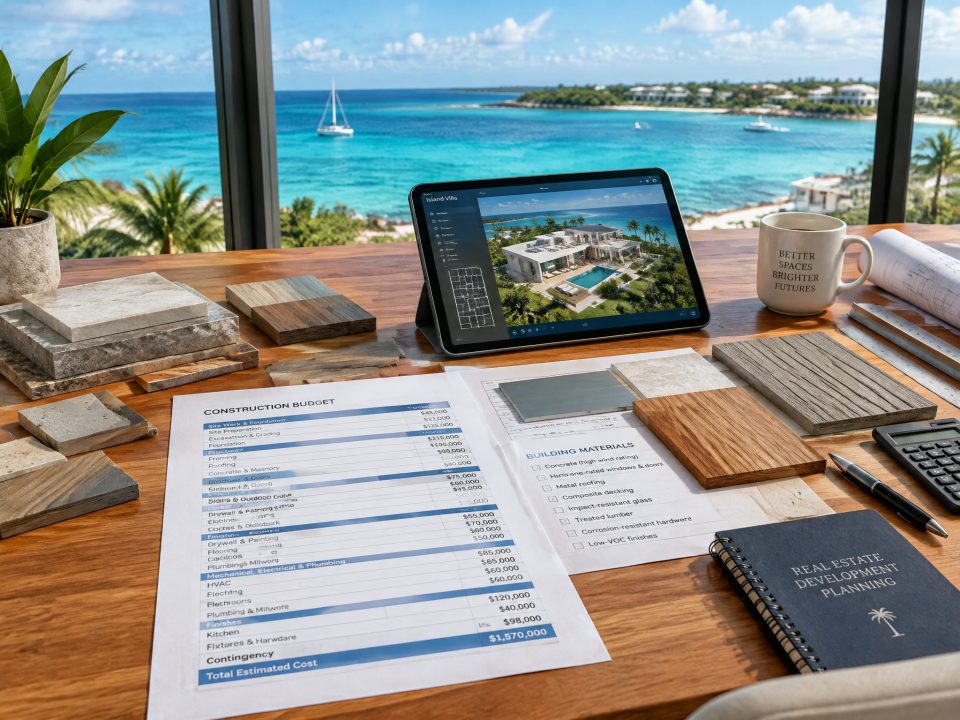
Construction costs in The Bahamas are influenced by far more than the size of the building. Imported materials, freight, duties and taxes, site conditions, hurricane requirements, logistics, specialist labour and the standard of finishes can all materially affect the final cost. The most reliable way to control cost is not to chase a single dollar-per-square-foot figure, but to define the intended standard clearly, make selections early, verify them carefully and understand the full delivered cost before committing to purchase.
Key takeaways
- Cost per square foot is an early benchmark, not a complete project budget.
- The price in a mainland showroom is not the installed cost in The Bahamas.
- Imported finishes require earlier decisions, stronger packaging and more careful checking.
- Returning the wrong size, colour or finish may be commercially impractical once goods have shipped and cleared Customs.
- Remote-site General Conditions can become a major part of the budget because supervision, accommodation, temporary utilities and transport continue for the life of the project.
- Hurricane resilience, salt-air durability and long-term maintainability should be treated as core cost considerations rather than optional upgrades.
- Early decisions usually cost less than late decisions.
THE COST OF THE HOUSE IS NOT THE COST OF THE PROJECT
Clients naturally ask: “What does it cost per square foot to build in The Bahamas?” It is a reasonable question, but there is no single reliable answer.
A square-foot figure generally describes some portion of the building itself. It may not include land, surveying, site clearing, excavation, rock breaking, retaining walls, fill, sea walls, docks, long utility connections, cisterns or water-treatment systems, septic or wastewater treatment, swimming pools, landscaping, boundary walls and gates, driveways, solar and battery systems, generators, furniture, professional fees, government fees and approvals, freight, logistics or contingency.
For a straightforward house on an easily accessible serviced lot, the difference may be manageable. For a waterfront property, steep site, remote Family Island or highly finished residence, these secondary costs can become a major part of the overall investment.
For that reason, we prefer to distinguish between building cost — what it costs to construct the house — and total project cost — what it costs to actually deliver the finished property the owner envisaged.
FINISH STANDARD CHANGES EVERYTHING
Two houses can contain exactly the same floor area and still have dramatically different budgets. The difference often lies in what the client means by a “good quality” home.
- Porcelain tile versus natural stone or large-format imported slabs
- Standard aluminium windows versus oversized impact-rated glazing
- Conventional cabinetry versus bespoke kitchens and millwork
- Stock plumbing and lighting versus designer fixtures and specialist lighting
- Painted doors and hardware versus custom hardwood doors and premium architectural hardware
Both owners may describe the desired project as “high quality.” They are not the same budget.
This is particularly important with international clients because expectations are usually established by the market they know. A homeowner accustomed to Miami, London or Toronto may visit a showroom and reasonably assume that a particular product is simply available. In The Bahamas, the more useful question is often not “How much does it cost?” but “What will it cost to get the correct product, undamaged, onto the site and installed?”
THE SHOWROOM PRICE IS ONLY THE BEGINNING
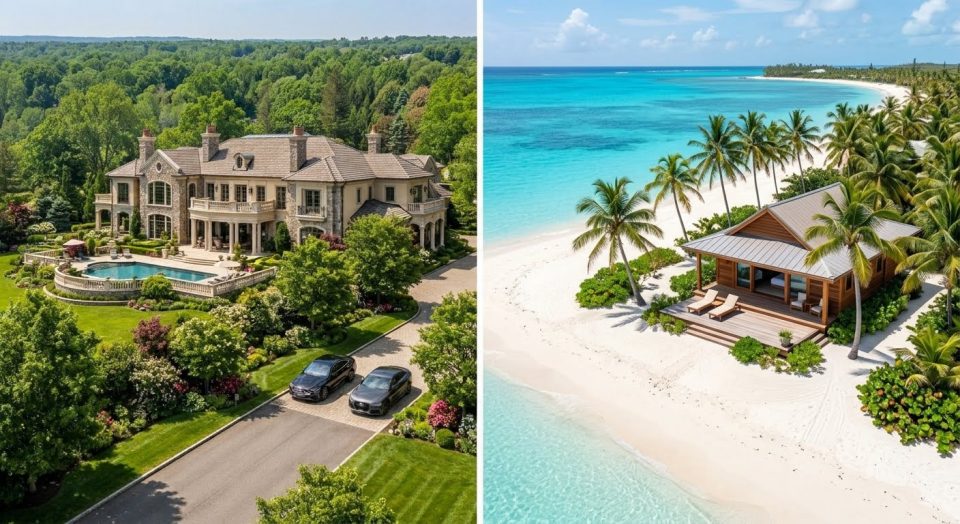
An imported item can pass through several cost layers before installation. Depending upon the product and the project, these may include:
- Purchase price
- Supplier delivery
- Export packing or crating
- Freight forwarding
- Ocean freight or air freight
- Marine insurance
- Customs duty where applicable
- Customs processing charges
- VAT
- Brokerage
- Port and landing charges
- Local trucking
- Inter-island freight where required
- Crane or forklift handling
- Site storage
- Installation
- Breakage or replacement allowance
This is why comparing a US retail price directly with the installed Bahamian cost can be misleading.
DUTY CONCESSIONS CAN HELP—BUT SHOULD BE VERIFIED FOR EACH PROJECT
Certain developments, locations or categories of building material may qualify for concessions or exemptions. These provisions can change by project type, location and legislation, and they should be verified before being incorporated into a project budget.
The budgeting principle is simple: never assume a concession until eligibility has been confirmed. A preliminary budget should show the normal tax treatment unless the owner and professional team have verified that the project qualifies for a specific exemption or incentive.
IMPORTED FINISHES REQUIRE MORE DISCIPLINE
This is one of the areas where building in The Bahamas differs most noticeably from building in a large mainland market. If a client in Florida orders the wrong bathroom faucet, the solution may be as simple as driving back to the supplier.
Once that faucet has been shipped to a freight forwarder, export-packed, loaded into a container, shipped internationally, cleared through Customs, delivered to Nassau and perhaps shipped again to a Family Island, the practical situation is very different. By then, saying “I don’t really like the finish” is not a small change.
The same problem arises with tiles, stone, plumbing fixtures, door hardware, lighting, appliances, cabinetry, windows, doors, furniture and specialist fittings. Approval before purchase therefore carries considerably more weight in an island environment.
REVIEW IT BEFORE YOU BUY IT
Before an important finish or manufactured item is released for purchase, the owner and design team should confirm as appropriate:
- Manufacturer, model number, colour and finish
- Dimensions, quantity and left-hand/right-hand configuration
- Electrical voltage, frequency and plumbing connections
- Compatible accessories, trim pieces and mounting hardware
- Rough openings and installation requirements
- Maintenance requirements and replacement-part availability
For major purchases, samples, shop drawings, photographs and finish boards should be reviewed and signed off. Where practical, we also favour requesting pre-shipment photographs of completed custom items.
For bespoke windows, doors, cabinetry, stonework and specialist equipment, the inconvenience of discovering an error after arrival can be considerable.
“I DIDN’T REALISE I WOULDN’T LIKE IT” IS EXPENSIVE AFTER SHIPPING

This may sound obvious, but it deserves to be stated plainly. Imported finishes should not be purchased on the assumption that they can easily be returned.
- The colour looks different in natural light.
- The stone has more variation than expected.
- The tile is glossier than anticipated.
- The tap is physically larger than it appeared online.
- The appliance projects too far from the cabinetry.
- The door hardware feels too lightweight.
- The furniture is uncomfortable.
In a mainland market, the financial consequence may be modest. In The Bahamas, the client may already have paid freight, duty, VAT, brokerage and delivery on something they now want to replace. That mistake can then be repeated in reverse by exporting or disposing of the unwanted item and importing another.
Our recommendation is simple: if the item is important to the finished appearance or expensive to replace, do not approve it casually.
PACKAGING IS PART OF THE PRODUCT
Standard domestic packaging may be completely adequate for moving an item from a warehouse to a nearby house. It may not be adequate for international and inter-island construction logistics.
A product bound for The Bahamas may be forklifted several times, loaded and unloaded from trucks, consolidated at a freight warehouse, placed in a container, exposed to vibration at sea, unloaded at a port, moved into temporary storage, reloaded for another island, transported along rough local roads and stored on a construction site.
For vulnerable products, enhanced packaging is often money well spent. This may include timber crates, reinforced corners, foam protection, moisture barriers, upright-only frames, glass racks, individual wrapping, clearly labelled packages, numbered components, packing lists and photographs before closing the crate.
The extra cost of appropriate packaging can be insignificant compared with replacing a damaged imported item.
OPEN AND INSPECT DELIVERIES PROMPTLY
An unopened crate sitting on site is not necessarily a completed delivery. Important shipments should be checked promptly for correct quantity, correct product, correct colour and finish, visible damage, missing components, broken glass, water intrusion, crushed packaging and incorrect dimensions.
Photographs should be taken where damage is evident. This is particularly important where freight or marine-insurance claims are subject to notification periods. Waiting several months until installation begins before opening an expensive shipment can leave the owner in a much weaker position if something is wrong.
THE SMALL PART THAT STOPS THE WHOLE JOB
One of the peculiarities of island construction is that an inexpensive missing component can delay work just as effectively as an expensive one.
- A proprietary mounting bracket
- A shower-valve rough-in
- The correct transformer
- A cabinet hinge
- A specialist anchor
- Door-cylinder extensions
- A missing trim kit
- A particular connector or manufacturer-specific sealant
On a mainland project, someone may collect the part the same afternoon. In The Bahamas, it may involve another order, courier charge, Customs clearance and several days—or weeks—of delay. Procurement should therefore be managed as a complete system, not simply as a collection of headline products.
LARGE WINDOWS AND DOORS ARE A COST CATEGORY OF THEIR OWN
One of the largest budget changes in contemporary Bahamian homes is the increasing use of oversized glazing. Large impact-rated sliding doors provide extraordinary views and indoor-outdoor living, but they bring several cost consequences:
- High purchase price and hurricane-performance requirements
- Heavy glass and special freight frames
- Higher shipping volumes
- Crane or lifting requirements
- More complex installation and structural coordination
- Waterproofing and replacement difficulty
A design containing extensive oversized glazing should therefore never be budgeted by simply applying a generic square-foot allowance derived from a more conventional house.
HURRICANE RESILIENCE IS NOT AN OPTIONAL UPGRADE
A Bahamian building must be designed for its environment, and that has cost implications. Depending upon the project, these may include reinforced masonry and concrete, engineered roof structures, structural connectors, impact-rated windows and doors, hurricane shutters, enhanced roof attachment, waterproofing systems, elevated equipment, backup generation, solar and batteries, and stormwater management.
These features may increase initial cost compared with construction in a less demanding climate, but reducing them merely to reach an arbitrary cost-per-square-foot target can be false economy.
SALT AIR CHANGES MATERIAL SELECTION
A product considered perfectly adequate inland may perform poorly close to the sea. Coastal exposure affects fasteners, door hardware, exterior lighting, air-conditioning equipment, electrical enclosures, railings, structural steel, aluminium, coatings, outdoor kitchens and pool equipment.
Marine-grade or enhanced products usually cost more. But the relevant comparison is not simply standard product versus premium product. It is initial cost + maintenance + replacement + inconvenience. A cheaper product that requires replacement every few years may be considerably more expensive over the life of the building.
LOCATION MATTERS
There is no single “Bahamas construction cost.” A house in Nassau and the same house on a remote cay are not the same project.
Additional Family Island costs may include inter-island freight, worker accommodation, worker transport, additional supervision, temporary power and water, material storage, plant mobilisation, crane mobilisation, limited concrete production, weather disruption and waste removal.
Even between Family Islands there can be substantial differences. Eleuthera, Abaco, Exuma and a remote private cay may each present completely different supply chains.
GENERAL CONDITIONS CAN BE A MAJOR PART OF THE COST
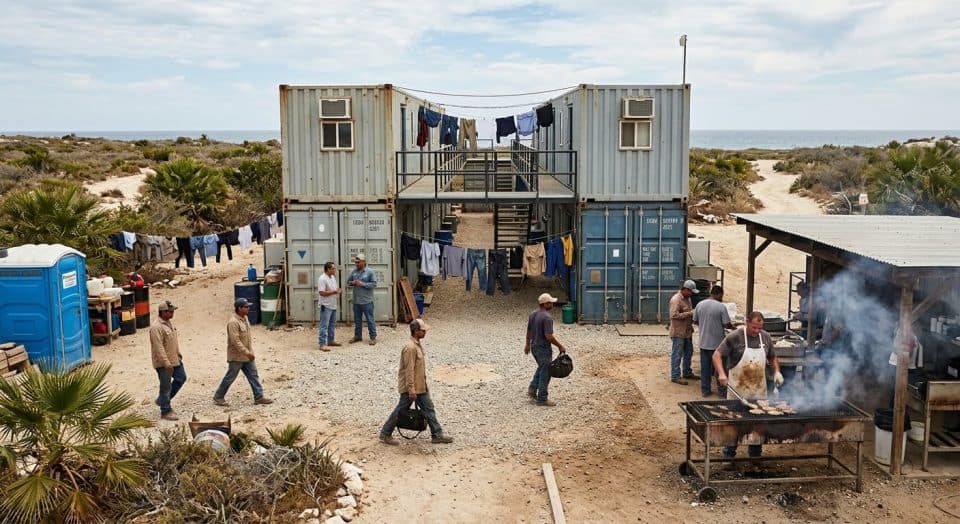
“General Conditions” are the project costs required to establish, manage and support the construction operation, but which do not become a physical part of the finished building. On an easily accessible project in Nassau these costs may be comparatively modest; on a remote island, private cay or difficult inland site they can become substantial.
Typical General Conditions can include site supervision and project management, temporary offices and storage, worker accommodation or a “man camp”, meals and potable water, temporary power and generator fuel, temporary water and sanitation, worker transportation, flights, ferries or boats, vehicles dedicated to the project, communications, internet, security, waste collection and removal, small tools, safety facilities, cleaning, mobilisation and demobilisation, and travel time to and from the site.
These costs are heavily influenced by time. If a project takes twelve months instead of ten, the contractor may carry another two months of supervision, accommodation, vehicles, generators, communications and site facilities.
On particularly remote projects, we have seen General Conditions approach 35–40% of the direct construction cost. This can occur where the contractor must establish and operate a self-contained workforce camp on a remote island or cay, but similarly high costs can arise on land-based projects where the site is two or three hours from the nearest settlement and workers, supervisors, fuel, materials and equipment must travel considerable distances every day.
This is why comparing contractor percentages between projects can be misleading. A contractor charging substantially higher General Conditions on a remote project may not necessarily be applying a larger profit margin—they may simply be carrying a much more expensive logistical operation.
Owners should therefore ask to see General Conditions identified separately and understand the assumptions behind them, including construction duration, number of site staff, workforce accommodation, transportation arrangements, temporary utilities, site security, equipment and vehicle requirements, waste removal, and mobilisation/demobilisation.
The most effective way to control these costs is often not to negotiate the percentage down, but to reduce the amount of time and logistical effort required to complete the project. Better documentation, earlier procurement, prefabrication, fewer late changes and a realistic construction programme can all have a direct effect on General Conditions.
SITE CONDITIONS MATTER JUST AS MUCH AS FINISHES
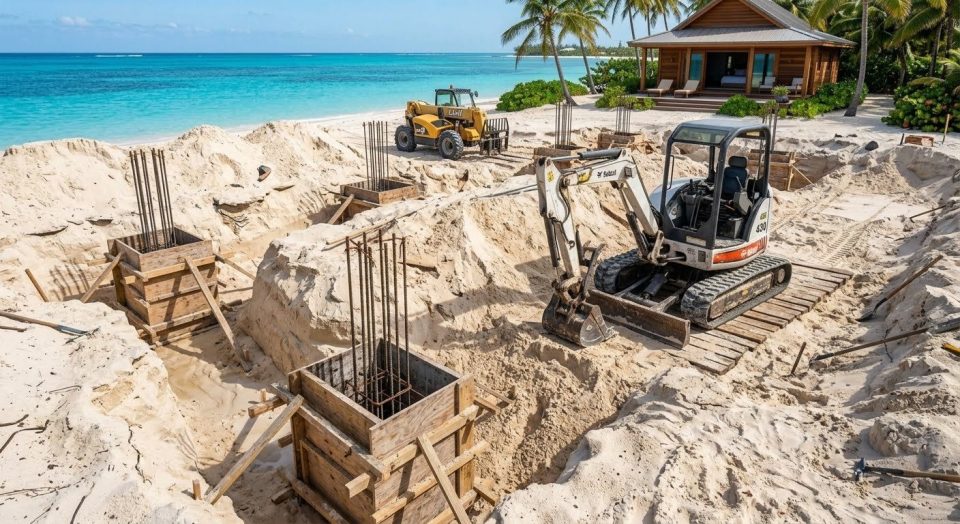
Owners understandably focus on what they will eventually see. Some of the most expensive parts of a project may be almost invisible when it is complete.
- Excavation and rock removal
- Fill, dewatering and foundations
- Retaining walls and drainage
- Utility extensions
- Seawalls and ground improvement
- Access roads
A relatively inexpensive parcel can therefore become a very expensive development site. This is why site due diligence should occur before purchase whenever possible.
POOLS, LANDSCAPING AND EXTERNAL WORKS SHOULD NOT BE AN AFTERTHOUGHT
High-end Bahamian homes often devote significant investment to the exterior. A completed project may include a swimming pool, spa, pool terrace, outdoor kitchen, gazebos, fire features, landscape lighting, irrigation, mature specimen planting, entry gates, boundary walls, guest parking, driveways, beach access, docks and outdoor showers.
These areas can represent a substantial percentage of the finished property cost yet are frequently omitted from early “house cost” conversations.
CHANGES DURING CONSTRUCTION ARE PARTICULARLY EXPENSIVE
Changes are expensive everywhere. They can be more expensive in The Bahamas because the consequences often extend beyond labour.
- Cancelling an imported order or paying restocking charges
- New freight and additional Customs costs
- Expedited air freight
- Reworking completed construction
- New engineering
- Delays while replacements arrive
- Remobilisation of trades
This is one reason we place considerable emphasis on resolving the design and selections before construction advances too far. The objective is not to prevent the client from changing their mind. It is to ensure that they understand when a decision stops being inexpensive to change.
ALLOWANCES NEED TO BE REALISTIC
A low allowance does not make an item inexpensive. It merely postpones recognition of the true cost.
If the client intends to use $2,000 sanitary fittings in a bathroom, a budget containing a $500 allowance will eventually produce an overrun. The same applies to tile, appliances, lighting, plumbing fixtures, hardware, cabinetry, stone and landscaping.
Good budgeting should reflect the owner’s actual expectations rather than using artificially low allowances to make the first estimate more attractive.
CONTINGENCY IS NOT THE SAME AS POOR PLANNING
Even a carefully designed project should carry an appropriate contingency. Construction contains uncertainty. For renovation work, difficult sites or remote locations, that uncertainty can be greater.
The contingency should not be treated as money available for upgrading finishes. It is a reserve for genuine unknowns. The better the design documentation, site investigation and procurement planning, the more intelligently that risk can be managed.
BEFORE SETTING A BUDGET, DEFINE THE PROJECT
Before relying on a construction budget, we would want to understand:
- Approximate building area, site location and site access
- Topography and coastal exposure
- Desired architectural and interior finish standard
- Window and door package
- Kitchen and bathroom standard
- Pool, external works and landscape expectations
- Solar, battery and generator requirements
- Staff or guest buildings
- Dock or marine works
- Imported versus locally available finishes
- Intended construction programme
Only then does a cost-per-square-foot discussion become genuinely useful.
The Plan It Bahamas perspective
After more than 23 years of designing and working with construction projects throughout The Bahamas, we have found that cost problems are often not caused by one enormous surprise. They are more often the accumulation of dozens of decisions that were not fully understood when they were made.
A finish selection is approved too casually. A large piece of equipment is ordered before access is checked. A custom item arrives without one important component. A colour is selected from a computer screen rather than a physical sample. A client assumes that an unwanted product can simply be returned. A provisional allowance bears little relationship to the finish level expected.
Individually, these may appear minor. Collectively, they can materially affect the project.
Our approach is therefore to establish the client’s expectations early, coordinate the design with realistic construction and procurement strategies, and make important decisions before they become expensive decisions.
Frequently asked questions
What does it cost per square foot to build in The Bahamas?
There is no reliable universal figure. Location, site conditions, hurricane requirements, glazing, finish standards, services, pools, landscaping and external works can produce very different costs for buildings of the same size. A square-foot rate is useful for early comparison only after the intended standard and scope have been defined.
Why do imported finishes cost so much more than the US price?
The supplier’s price is only the starting point. Depending on the item, the delivered cost can include export packaging, freight, insurance, Customs duty, VAT, brokerage, port charges, local transport and installation.
Can I return something if I don’t like it when it arrives?
Possibly, but it may not be economically sensible. International freight, Customs clearance, handling and taxes may already have been incurred, and returning the product can create additional freight and restocking costs. For important finishes, the better approach is to review samples, dimensions and specifications carefully before authorising purchase.
Should imported goods be specially packaged?
For fragile, valuable or bespoke products, often yes. Standard domestic packaging may not be designed for repeated handling, sea freight, consolidation and island transport. Appropriate crating and protection should be discussed with the supplier before shipment.
Why does Plan It Bahamas ask clients to approve so many selections before ordering?
Because changing a selection before it is purchased can be relatively simple. Changing it after manufacture, shipping and Customs clearance can be expensive and slow. Written approval also helps ensure that the client, architect, supplier and contractor are working from the same information.
What are General Conditions, and why can they be so high on a remote project?
General Conditions are the costs of running the construction operation rather than the cost of the permanent building itself. They can include supervision, temporary facilities, accommodation, transport, power, water, security, communications and other site-support expenses. On remote projects these costs can be substantial because the contractor may effectively have to create and operate a small temporary settlement for the duration of the job.
Are building materials always subject to duty?
No. Rates depend on the tariff classification and some projects or locations may qualify for concessions. These rules should be verified for the actual project and product rather than assumed from a previous job.
Is it more expensive to build on a Family Island?
Often, but not by a standard percentage. The difference depends on local labour, freight, access, accommodation, concrete, equipment, utilities and the amount of specialist work that must be brought from elsewhere.
How can a client control construction costs most effectively?
The strongest controls are usually early decisions, complete drawings, realistic allowances, clear specifications, disciplined procurement, transparent pricing and careful management of changes once construction begins.
Conclusion
Construction in The Bahamas does not need to be unpredictable, but it does need to be approached differently from a project in a large mainland market.
The most successful projects recognise that the cost of a material is not simply its purchase price and the cost of a house is not simply its square footage. Design quality, durability, freight, taxation, site conditions, logistics, General Conditions, maintenance and the owner’s expectations all form part of the equation.
Choose carefully before ordering. Check carefully before shipping.
Once an item has travelled hundreds of miles, passed through Customs and arrived on a Bahamian construction site, it is usually too late to discover that it is the wrong size, the wrong colour—or simply not what you thought you were buying.
Discuss a project with us
If you are planning a project in The Bahamas and would like to talk through the architectural and coordination implications early, we would be glad to hear from you.
Contact Plan It BahamasSources
- Bahamas Customs Department — Customs Management Regulations, 2013. Relevant to customs valuation, packing, freight, insurance and related import costs.
- Department of Inland Revenue — Value Added Tax guidance and FAQs. Relevant to VAT treatment of imported goods and landed-cost calculations.
- Department of Inland Revenue — VAT Guidance on the Transportation of Passengers and Goods. Relevant to freight and associated charges in the VAT value of imported goods.
- Government of The Bahamas — current customs tariff, concession and Family Island development legislation. Eligibility and rates should be verified for each project at the time of budgeting.
- Plan It Bahamas — professional observations based on project delivery experience throughout The Bahamas. Project-specific cost percentages, including General Conditions, are illustrative of experience and not universal market rates.
Authorship and review
- Prepared by
- Plan It Bahamas
- Originally published
This article is intended as general architectural and project-planning guidance. It does not replace project-specific legal, planning, environmental, engineering, quantity-surveying, construction, insurance or utility advice. Conditions vary significantly between islands and individual sites.